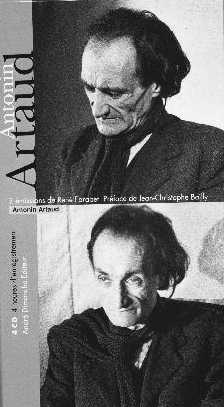
I had a conversation with Russell the other day about the failure of language. We were discussing Artaud’s theories and proclamations about the inherent evil of language. Art, then, seems to be the answer to the Artaudian and post-structuralist view. After all of this, and the realization that we were getting nowhere and had to return to work to toil away the precious hours of our lives, I finished reading Lenz. When I started this story I was immediately struck by the Romantic era writing. Having just read Artaud and Sarah Kane’s 4.48 Psychosis I was not wholly prepared to encounter a “traditional” approach. Yet, here was Buchner painting beautiful landscapes of the  German and Switzerland border. Here was Buchner getting lost in the description of nature. Here was Buchner celebrating the natural world and the author’s ability to capture it. As I was reading I could picture such famous Romanticism works as Caspar David Friedrich’s “Wanderer Above the Sea of Fog.” I was not impressed. The modernist in my head kept screaming, “Make it new!” Then Lenz went crazy and everything changed. Suddenly, Buchner heard Ezra Pound and Artaud from generations yet to come and made it new. As Lenz drifts into insanity, the structure of the story changes; we leave the Romanticism behind and seem to speed toward Expressionism.
Lenz, save for a few areas, cannot easily be expressed as literature. The feel and makeup of this piece lends itself to art. If the first half of this story finds itself in comparison to Friedrich, then the latter half finds itself a precursor to the works of Edvard Munch. Two paintings jumped to my mind as I read the latter part of Lenz. The first was “The Scream.” I pictured that fa mous painting when I read, “something was stirring and swarming toward an abyss toward which he was being swept by an inexorable force” (47). The anxiety and uncertainty of this line captures what Munch would express in painting nearly 60 years later. This line, along with countless others, expresses so unequivocally what Artaud would write some 80 years later. Artaud’s words fail him; his terms are never defined, for each word is reliant on the previous…until what? Until there is a final word? The finite and finality in this supposed word is what drives people like Artaud and Lenz (both fictional and non) to insanity. The inability of this supposed final word is what drives others to art.

 German and Switzerland border. Here was Buchner getting lost in the description of nature. Here was Buchner celebrating the natural world and the author’s ability to capture it. As I was reading I could picture such famous Romanticism works as Caspar David Friedrich’s “Wanderer Above the Sea of Fog.” I was not impressed. The modernist in my head kept screaming, “Make it new!” Then Lenz went crazy and everything changed. Suddenly, Buchner heard Ezra Pound and Artaud from generations yet to come and made it new. As Lenz drifts into insanity, the structure of the story changes; we leave the Romanticism behind and seem to speed toward Expressionism.
Lenz, save for a few areas, cannot easily be expressed as literature. The feel and makeup of this piece lends itself to art. If the first half of this story finds itself in comparison to Friedrich, then the latter half finds itself a precursor to the works of Edvard Munch. Two paintings jumped to my mind as I read the latter part of Lenz. The first was “The Scream.” I pictured that fa
 mous painting when I read, “something was stirring and swarming toward an abyss toward which he was being swept by an inexorable force” (47). The anxiety and uncertainty of this line captures what Munch would express in painting nearly 60 years later. This line, along with countless others, expresses so unequivocally what Artaud would write some 80 years later. Artaud’s words fail him; his terms are never defined, for each word is reliant on the previous…until what? Until there is a final word? The finite and finality in this supposed word is what drives people like Artaud and Lenz (both fictional and non) to insanity. The inability of this supposed final word is what drives others to art.
 The other painting by Munch that leaped to mind whilst reading of Lenz’s exploits into the abyss was “The Sick Child.” The scene in this painting and the scene in which Munch paints are very similar, so similar in fact that it could probably be argued that Munch had read Lenz.
“The child seemed so forsaken and he himself so alone and isolated; he threw himself on the corpse; death terrified him, raw pain shot through him, these features, this quiet face were soon to rot away, he fell to his knees, he prayed with the full misery of despair that God…” (53)
With this image in my head I find myself wondering if language is all that inadequate. Clearly it is, it’s been proven since Plato’s Phaedrus, yet here we have a writer so clearly and beautifully transcribing a scene that only later manifests itself into art. Perhaps the main theme in Lenz can be understood that we experience the world visually, that the sane mind takes in the world, admires its beauty and its colors. The insane mind takes in the feel, he can see the pain, he can see the failure. Perhaps Lenz is one of the only written works that is both prose and painting. It is only through this amalgamation that meaning can begin to surface.