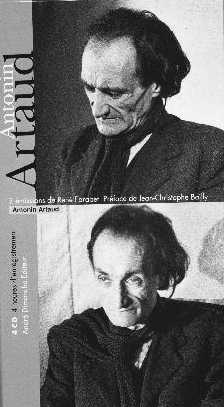
I’m not one for “profound thoughts of mind,” as Beckett would say; but, I am one to steal lyrics from popular musical acts like Interpol. The theme of this class, as appears to be the theme of Artaud, is to explore and expose theatre. What is theater, and maybe more importantly, why does it matter? As I was driving home from class one undated and mostly forgotten day, Interpol was playing on my iPod. It’s a song that I know very well, so well that it doesn’t affect me; it doesn’t even register in my head as it plays. However, the lyrics “in a passion it broke / I pull the black from the gray / but the soul remains” stood out. I was reflecting on Artaud’s letters and his purpose (too strong a word). It struck me that Artaud was attempting to pull the black from the gray (or maybe the white) to expose us to the soul of theater.

Artaud’s letters center around his desire to get published. He is committing literary faux pas by seemingly harassing an editor who did not publish his work. Artaud, however, asserts that he does not care about his poems being published; instead his aim is to be made to exist. Like every writer, Artaud is writing for posterity. What separates Artaud from the pack is Artaud feels he cannot exist, he may not exist, if he is not captured in some permanent manner.
“I nevertheless offer [these poems] to existence. I have felt and accepted these phrases, these ungainly expressions which you criticize…They come from the deep uncertainty of my thinking. Fortunate indeed when this uncertainty is not replaced by the absolute inexistence from which I sometimes suffer.”
When the publisher finally realizes that Artaud is not just advocating himself (though that is his chief aim), but a new way of seeing (Artaud as Rimbaud’s Seer), he offers to publish the letters they’ve exchanged. The publisher suggests publishing them as works of fiction, or at least changing their names. To this Artaud writes, “why lie, why try to place on a literary level a thing which is the very cry of life?” This brings me back around to the Interpol song. Artaud’s goal—as I’ve already presumptuously titled it—is to expose drama to life. He is attempting to pull the black (sometimes white) from the gray and show that in doing so the soul remains. That art, drama, poetry, all of it is experienced on such a level that we lie to ourselves and classify what we’ve witnessed as literary. Perhaps it’s not literary; perhaps it’s just the cry of life.
To further stretch the already fully stretched, this Artaudian decree of why lie, why mask the cry of life, can be traced beyond just the works of Artaud or the others studied in this class. It seems to me that the Beat generation embodied this notion as well. Writers like Jack Kerouac and his ilk were less concerned with the literary value of their works and more concerned with exposing the very cry of life.


No comments:
Post a Comment